
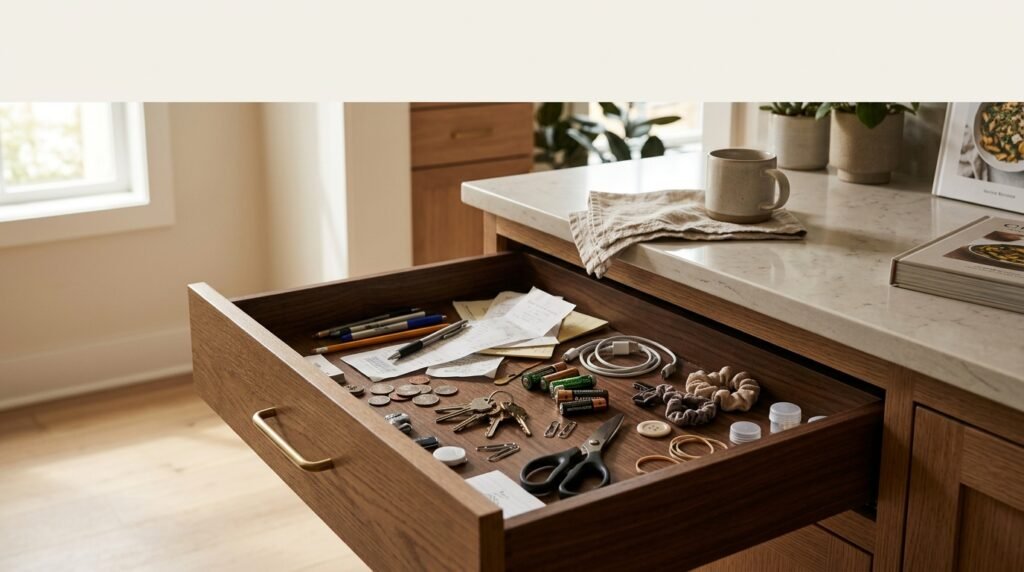
Almost every home has one. You pull open a drawer in the kitchen or hallway, intending to drop in a stray rubber band, and find yourself staring into a small ecosystem of everyday life. There are old paper receipts, half-used batteries, a couple of dried-up pens, an unidentified charging cable, a spare set of house keys, loose coins, pair of kitchen scissors, a crumpled takeout menu, and a collection of tiny, miscellaneous parts that belong to something you probably purchased three years ago.
It is easy to label this space the “junk drawer” or the “drawer of doom” and feel a slight prickle of guilt every time it jams shut. But the problem is rarely the drawer itself. When you take a closer look, effective junk drawer organization isn’t about hiding tiny messes; it is about recognizing what those messes are trying to tell you. More often than not, the drawer fills up simply because those items lack a designated, easy-to-reach home anywhere else in your house.
Why Does Everything End Up in One Drawer?
To fix a drawer that constantly collects stray objects, it helps to understand why it happens in the first place. Items do not drift into the drawer of doom by accident—they end up there because of convenience and decision fatigue.
At the end of a long afternoon, when you walk through the door holding a spare key or a stray button, your brain naturally seeks the path of least resistance. If putting an item back in its proper place requires walking upstairs, opening a high cabinet, or finding a label maker, you will put it in the nearest flat surface or open drawer instead.
Small, uncategorized objects are notoriously difficult to place. A single battery or an extra Allen wrench doesn’t feel like it warrants a whole bin or labeled drawer, so it enters a state of temporary storage. The trouble is that without a periodic reset, temporary storage slowly becomes permanent storage. Over time, the drawer becomes a holding zone for deferred decisions: things you aren’t sure you need, don’t know where to put, or intend to deal with later when you have more time.
The Problem Isn’t Always Clutter
It is easy to assume that the existence of a junk drawer means you have too much stuff or that you are fundamentally disorganized. But having possessions is not a design flaw. A lived-in home naturally accumulates useful tools, sentimental objects, hardware, and everyday supplies.
There is a distinct difference between having belongings and having belongings without a functional system. The goal of sensible home organization is never extreme minimalism, nor is it to turn your house into a pristine showroom where nothing looks touched. A home should comfortably support the real lives of the people who live inside it.
When your everyday items are easy to find and simple to put away, small amounts of physical clutter cease to feel overwhelming. The drawer of doom only becomes a frustration when you can no longer find what you actually need—like a working pen, a tape measure, or a pair of scissors—when you need it most.
How to Organize a Junk Drawer Without Making It Complicated
Organizing this space does not require a full afternoon, nor does it demand intricate labeling systems. You can create a practical, working drawer in about twenty minutes using four straightforward steps.
Take Everything Out
Start by completely clearing the drawer. Empty the entire contents onto a clean counter or table. Seeing everything at once breaks the psychological habit of ignoring what is tucked away in the back corners. Wipe down the empty drawer so you are starting with a clean slate.
Create Four Simple Categories
Sort the contents into four distinct piles:
- Keep: Essential, frequently used items that genuinely belong in this location.
- Move: Useful items that belong somewhere else in the home (such as tools that belong in the garage, or paperwork that belongs in a filing cabinet).
- Give Away: Duplicates or working items that you no longer need or use.
- Discard: Dried-up pens, expired coupons, mystery parts for long-gone appliances, and broken knick-knacks.
Group Similar Things Together
Look at the items remaining in your “Keep” pile and group them into logical clusters. Place batteries with batteries, stationery with stationery, keys with keys, and small hardware tools together. Categorizing by group rather than trying to organize individual objects makes the drawer far easier to maintain over time.
Give Each Category a Home
Re-introduce your items to the drawer, assigning each group a defined zone. Effective drawer organization should always answer a simple question: “Where does this type of thing belong?” rather than “Where can I quickly hide this?” When every category has a clear boundary, returning items to their place takes no mental effort.
Don’t Buy an Organizer Yet
When starting a decluttering project, the temptation is often to head straight to the store or browse online for sets of sleek acrylic dividers and matching bins. However, buying containers before you fully understand what you need to store often leads to more clutter, not less. Container dimensions might not fit your drawer correctly, or you may find yourself trying to force your belongings to fit into predetermined compartments.
Before purchasing anything new, look around your house for simple storage solutions you already own. Small sturdy cardboard boxes, shallow ceramic bowls, clean gift box lids, or small metal tins make excellent dividers. Using existing containers allows you to test out your new layout for a few weeks without spending money or adding extra plastic to your home.
If, after using your improvised system, you realize that a dedicated tray would genuinely improve the drawer’s functionality, then go ahead and measure carefully to make an intentional purchase. But more often than not, your home doesn’t need more storage; it simply needs a clearer arrangement of the things you actually use.
What Your Junk Drawer Might Be Telling You About Your Home
Once you clear out the excess, pay attention to what was living in that drawer. The patterns you find can offer surprisingly helpful insights into how your entire household functions.
- Missing homes for whole categories: If you found six charging cables and three pairs of reading glasses, it indicates that charging cords and eyewear don’t have a functional, central home elsewhere in your house.
- Friction in your daily habits: If receipts and mail dominate the space, your current system for handling incoming paper might be too complicated or placed too far from the front door.
- Excessive duplicates: Finding four tape measures or dozens of half-used notepad pads reveals a pattern of buying replacements simply because the originals were misplaced.
- “Just in case” thinking: Keeping mystery screws, unknown keys, and manual inserts suggests a fear of letting go of small things, even when they no longer serve a clear purpose.
Addressing these root causes prevents clutter from simply migrating to another surface or drawer in your home.
Make Your Organization System Easy to Maintain
The true test of any simple organization system is not how beautiful it looks immediately after you sort it. The true test is whether you can easily maintain it on a tired Tuesday evening when you are making dinner, handling laundry, and rushing between tasks.
If putting a pair of scissors back requires removing three other items or fitting a lid onto a tight container, the system will break down. Lower the barrier to entry as much as possible. Categories should be broad, containers should be open, and access should be direct. If a system feels fussy or high-maintenance, simplify it until returning an item to its spot requires only one single motion.
The One-Minute Reset
To keep your newly organized home spaces from slipping back into chaos, adopt a quick, low-effort maintenance routine. Once a week—perhaps while waiting for the morning coffee to brew or dinner to finish on the stove—open the drawer for a quick one-minute reset.
Pick out anything that was tossed in by mistake, discard any new paper scraps or dead batteries, and ensure your main categories remain in their assigned zones. A sixty-second check-in every few days completely eliminates the need for massive, overwhelming decluttering sessions down the road.
Your Home Doesn’t Need to Be Perfect
At Little Comfort Finds, we firmly believe that homes are meant to be lived in, not preserved like museum exhibits. Possessions will move around, busy weeks will happen, and stray items will inevitably land on the kitchen counter or in a hallway drawer from time to time.
An organized home isn’t one where clutter never occurs; it is one where clearing clutter is light, fast, and stress-free because everything has a clear place to return to. When your systems are built around your real life rather than an unrealistic standard of perfection, your home becomes a far more comfortable, restful place to be.
Frequently Asked Questions
What should actually go in a junk drawer?
A functional drawer should hold everyday, frequently used utility items that don’t belong in a specific room. Common examples include a pair of scissors, a roll of tape, a working pen, a small notepad, spare house keys, and a flashlight. If an item isn’t used regularly, it should be stored in a primary location like a desk, tool kit, or utility closet.
How do I organize a junk drawer without buying organizers?
Use shallow containers you already have at home. Small gift box lids, shallow tea tins, small ceramic dishes, or sturdy cardboard packaging inserts work exceptionally well as dividers. You can also trim clean cereal boxes down to fit the height of your drawer to create custom, zero-cost compartment dividers.
How often should I clean out a junk drawer?
With a clear system in place, a deep clean is rarely needed. Doing a quick one-minute sweep once a week to remove stray receipts or trash keeps the space tidy. A more thorough review every six months is usually enough to clear out accumulated items that no longer belong.
What should I do with items that don’t have a clear home?
If you consistently find items that don’t fit into existing categories, create a temporary “holding box” in a closet or cabinet. If you don’t look for or use those items within a month or two, it is usually a strong signal that they can be safely donated or discarded.